Hvem daterede Itō Noe?
Sakae Ōsugi dateret Itō Noe fra ? indtil ?. Aldersforskellen var 10 år, 0 måneder og 4 dage.
Jun Tsuji dateret Itō Noe fra ? indtil ?. Aldersforskellen var 10 år, 3 måneder og 17 dage.
Itō Noe
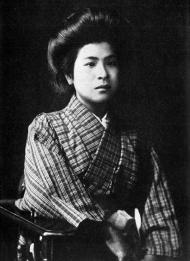
Itō Noe (伊藤 野枝; January 21, 1895 – September 16, 1923) was a Japanese anarchist, social critic, author, and feminist. She was the editor-in-chief of the feminist magazine Seitō (Bluestocking). Her progressive anarcha-feminist ideology challenged the norms of the Meiji and Taishō periods in which she lived. She drew praise from critics by being able to weave her personal and political ideas into her writings. The Japanese government, however, condemned her for challenging the constructs of the time. She became a martyr of the anarchist ideology in which she believed during the Amakasu Incident, when she was murdered along with her lover, anarchist author Ōsugi Sakae, and his nephew.
Læs mere...Sakae Ōsugi
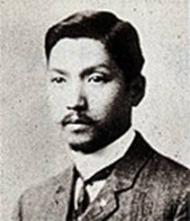
Ōsugi Sakae (Japanese: 大杉 栄; 17 January 1885 – 16 September 1923) was a Japanese anarchist, writer, and social critic of the Taishō period. His thought centered on individualism, direct action, and the "expansion of the ego" as philosophical underpinnings for social and personal revolution. His advocacy of free love and his controversial personal life, which included simultaneous relationships with three women, led to a violent attack against him and his temporary ostracism from the socialist movement.
Born into a military family, Ōsugi was expelled from military school for insubordination and turned to language studies and radical politics in Tokyo. After a series of prison terms between 1906 and 1910, which he considered his "real education," he emerged as a leading voice in the Japanese anarchist movement. Through his journals, such as Kindai shisō (Modern Thought) and Rōdō undō (The Labor Movement), he introduced the works of European thinkers like Peter Kropotkin, Georges Sorel, and Henri Bergson to Japan, synthesizing their ideas into his own philosophy. He became a key figure in the Japanese labor movement, advocating for syndicalism and workers' autonomy while strongly criticizing both state authority and the emerging Bolshevism.
In the chaotic aftermath of the 1923 Great Kantō earthquake, Ōsugi, his partner and fellow anarchist Itō Noe, and his six-year-old nephew were arrested by a squad of military police led by Captain Amakasu Masahiko. They were beaten and strangled, their bodies disposed of in a well. Their murders, known as the Amakasu Incident, became a symbol of state violence against radicals during the period.
Læs mere...Itō Noe
Jun Tsuji
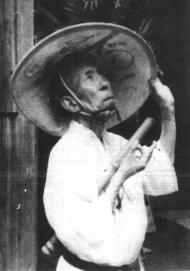
Jun Tsuji (辻 潤), plus tard appelé Ryūkitsu Mizushima, né le à Tokyo et décédé de sous-alimentation à l'âge de 60 ans le dans cette même ville, est un écrivain japonais, poète, essayiste, dramaturge et traducteur. Il est également décrit en tant que dadaïste, nihiliste, épicurien, joueur de shakuhachi, acteur et bohéme. Il est l'auteur des premières traductions japonaises de L'Unique et sa propriété de Max Stirner et L'Homme de génie de Cesare Lombroso.
Né à Tokyo, Jun Tsuji s'évade dans la littérature dès son enfance qu'il décrit comme « rien d'autre que de la misère et de la souffrance, une série de difficultés traumatisantes ». Il commence ensuite à s'intéresser à l'humanisme tolstoïen, à l'anarchisme socialiste de Shūsui Kōtoku, à la littérature d'Oscar Wilde et de Voltaire et de beaucoup d'autres. Plus tard, en 1920, Tsuji découvre le dadaïsme et s'autoproclame premier dadaïste du Japon, titre également revendiqué par son contemporain Takahashi Shinkichi. Tsuji devient un fervent partisan de l'anarchisme égoïste issue de la philosophie de Max Stirner (en), ce qui sera un sujet de discorde entre lui et Takahashi. Tsuji réalise en 1929 la préface du recueil de poésie Ao Uma wo Mitari (« J'ai vu un cheval pâle ») de la féministe Fumiko Hayashi et est très actif dans les milieux artistiques radicaux de son temps.
Læs mere...