Hvem daterede Adèle de France (née en 1160)?
Richard Løvehjerte dateret Adèle de France (née en 1160) fra ? indtil ?. Aldersforskellen var 3 år, 0 måneder og 19 dage.
Henrik 2. af England dateret Adèle de France (née en 1160) fra ? indtil ?. Aldersforskellen var 27 år, 6 måneder og 22 dage.
Adèle de France (née en 1160)
Aélis de France (ou Adélaïde, Alixou encore Adèle, née le 4 octobre 1160, † apr. ), est la fille du roi Louis VII de France (1120-1180) et de sa deuxième épouse, Constance de Castille, qui meurt en accouchant de sa fille.
Læs mere...Richard Løvehjerte
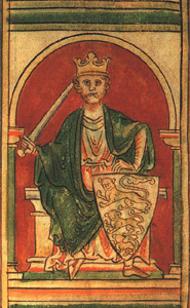
Richard 1. af England (Richard Løvehjerte; født 8. september 1157 på Beaumont Palace i Oxford i England, død 6. april 1199 i Châlus (nu Limousin, Frankrig), Hertugdømmet Aquitaine) var konge af England fra 1189 til 1199. Han deltog i det 3. korstog til Det hellige land.
Han var hertug af Normandiet, hertug af Aquitaine, hertug af Gascogne, herre over Cypern, greve af Anjou, greve af Nantes og overherre af Bretagne i forskellige perioder. Han er mest kendt som "Richard Løvehjerte", på fransk som "Cœur de Lion", før han blev konge på grund af sit ry som en stor militær leder og kriger.
Richard var den tredje søn af Henrik den 2. og Eleonora af Aquitanien. Han havde fire brødre og tre søstre og var i slægt med flere fyrstehus i Europa. Hans yngste bror Johan fulgte ham som konge.
Richard havde allerede kommando over sin egen hær, da han var 16 år og nedkæmpede et oprør i Poitou mod faren. Han var en af de vigtigste kristne ledere i det tredje korstog og ledede i praksis felttoget, efter at den franske konge, Filip 2. August, havde forladt korstoget. Han vandt flere vigtige sejre over sin muslimske modstander, Saladin.
Han talte dårligt engelsk og tilbragte meget lidt tid i sit kongedømme. Hovedsagelig brugte han det som en indtægtskilde for at finansiere sine soldater. Alligevel blev han anset som en from helt af sine undersåtter. Han er forblevet en ikonisk figur i England og i populærkulturen og er en af de få engelske konger, som huskes mere for tilnavn end for nummer i kongerækken.
Han var gift med Berengaria af Navarra.
Læs mere...Adèle de France (née en 1160)
Henrik 2. af England

Henry II ( (1133-March-05) (1189-July-06)5 March 1133 – 6 July 1189) was King of England from 1154 until his death in 1189. During his reign he controlled England, substantial parts of Wales and Ireland, and much of France (including Normandy, Anjou, and Aquitaine), an area that was later called the Angevin Empire, and also held power over Scotland for a time and the Duchy of Brittany.
Henry was the eldest son of Geoffrey Plantagenet, Count of Anjou, and Matilda, daughter of Henry I of England. By the age of fourteen, he became politically and militarily involved in his mother's efforts to claim the English throne, at that time held by her cousin Stephen of Blois. Henry's father made him Duke of Normandy in 1150, and upon his father's death in 1151, Henry inherited Anjou, Maine and Touraine. His marriage to Eleanor of Aquitaine brought him control of the Duchy of Aquitaine. Thus, he controlled most of France. Henry's military expedition to England in 1153 resulted in King Stephen agreeing, by the Treaty of Wallingford, to leave England to Henry; he inherited the kingdom at Stephen's death a year later.
Henry was an energetic and ruthless ruler, driven by a desire to restore the royal lands and prerogatives of his grandfather Henry I. During the early years of his reign Henry restored the royal administration in England, which had almost collapsed during Stephen's reign, and re-established hegemony over Wales. Henry's desire to control the English Church led to conflict with his former friend Thomas Becket, the Archbishop of Canterbury. This controversy lasted for much of the 1160s and resulted in Becket's murder in 1170. Soon after his accession, Henry came into conflict with Louis VII of France, his feudal overlord, and the two rulers fought over several decades in what has been termed a "cold war". Henry expanded his empire at Louis's expense, taking Brittany and pushing east into central France and south into Toulouse. Despite numerous peace conferences and treaties, no lasting agreement was reached.
Henry and Eleanor had eight children. Three of their sons were kings, Henry the Young King as co-ruler with his father and Richard I and John as sole monarchs. As his sons grew up, Henry struggled to find ways to satisfy their desires for land and immediate power, and tensions rose over the future inheritance of the empire, encouraged by Louis VII and his son Philip II, who ascended to the French throne in 1180. In 1173 Henry's heir apparent, "Young Henry", rebelled against his father. He was subsequently joined in his rebellion by his brothers Richard and Geoffrey as well as their mother. Several European states allied themselves with the rebels, and the Great Revolt was defeated only by Henry's vigorous military action and talented local commanders, many of them "new men" appointed for their loyalty and administrative skills. Young Henry and Geoffrey led another revolt in 1183, during which Young Henry died of dysentery. Geoffrey died in 1186. The Anglo-Norman invasion of Ireland provided lands for Henry's youngest son, John. By 1189, Philip swayed Richard to his side, leading to a final rebellion. Decisively defeated by Philip and Richard and suffering from a bleeding ulcer, Henry retreated to Chinon Castle in Anjou. He died soon afterwards and was succeeded by his son Richard.
Henry's empire quickly collapsed during the reign of his son John, but many of the changes Henry introduced during his lengthy rule had long-term consequences. Henry's legal reforms are generally considered to have laid the basis for the English Common Law, while his intervention in Brittany, Wales, Ireland, and Scotland shaped the development of their societies, histories, and governmental systems. Historical interpretations of Henry's reign have changed considerably over time. Contemporary chroniclers such as Gerald of Wales and William of Newburgh, though sometimes unfavourable, generally lauded his achievements. In the 18th century, scholars argued that Henry was a driving force in the creation of a genuinely English monarchy and, ultimately, a unified Britain. During the Victorian expansion of the British Empire, historians were keenly interested in the formation of Henry's own empire, but they also criticized certain aspects of his private life and treatment of Becket.
Læs mere...