Hvem daterede Lyudmila Erarskaya?
Sophia Parnok dateret Lyudmila Erarskaya fra ? indtil ?.
Lyudmila Erarskaya
Lyudmila Erarskaya (Russian: Людмила Владимировна Эрарская, 1890–1964), was a Russian actress who performed from the pre-revolutionary period until her death in Moscow in 1964. She was an associate and friend of some of the most noted intellectuals of her era and was most known for her relationship with and inspiration of poems by Sophia Parnok.
Læs mere...Sophia Parnok
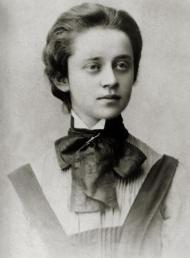
Sophia Yakovlevna Parnok (Russian: София Яковлевна Парнок, Yiddish: סאָפיאַ פארנוכ; 30 July 1885 O.S./11 August 1885 (N.S.) – 26 August 1933) was a Russian poet, journalist and translator. From the age of six, she wrote poetry in a style quite distinct from the predominant poets of her times, revealing instead her own sense of Russianness, Jewish identity and lesbianism. Besides her literary work, she worked as a journalist under the pen name of Andrei Polianin. She has been referred to as "Russia's Sappho", as she wrote openly about her seven lesbian relationships.
Sonya Yakovlevna Parnokh was born into a well-to-do family of professional Jews in a provincial city outside the Pale of Settlement. Her mother died after giving birth to her twin siblings and she was raised by her father and her step-mother, leaving her feeling her childhood lacked emotional support. From a young age, she wrote poetry and acknowledged her uniqueness—her lesbianism, her Graves' disease, and her religion—which set her apart from her peers.
Completing her studies at the Mariinskaya Gymnasium, in 1905 Parnok moved to Geneva and attempted to study music, but lacked any real drive and quickly returned to Moscow. To distance herself from her father's control and her financial dependence on him, she published her first book of poems in 1906 under the pseudonym Sophia Parnok and married Vladimir Volkenstein in 1907. Within two years, the marriage failed and she began working as a journalist.
From 1913, Parnok exclusively had relationships with women and used those love relationships to fuel her creativity. In a succession of relationships with Marina Tsvetaeva, Lyudmila Erarskaya, Olga Tsuberbiller, Maria Maksakova and Nina Vedeneyeva, her muses propelled her to publish five collections of poetry and write several librettos for opera, before her disease claimed her life in 1933.
Her poetry was banned after 1928, and her work almost forgotten until 1979 when her collected works were published for the first time. While scholars have focused on her early influential relationship with Tsvetaeva, her best works are now recognized as those written from 1928.
Læs mere...